From Upcycled Sawdust to Signature Scent
How a byproduct nobody wanted became a new fragrance ingredient: LOSiam's Teak Absolute, developed with CMU Biopolis, FIN and Thailand's DIPROM.
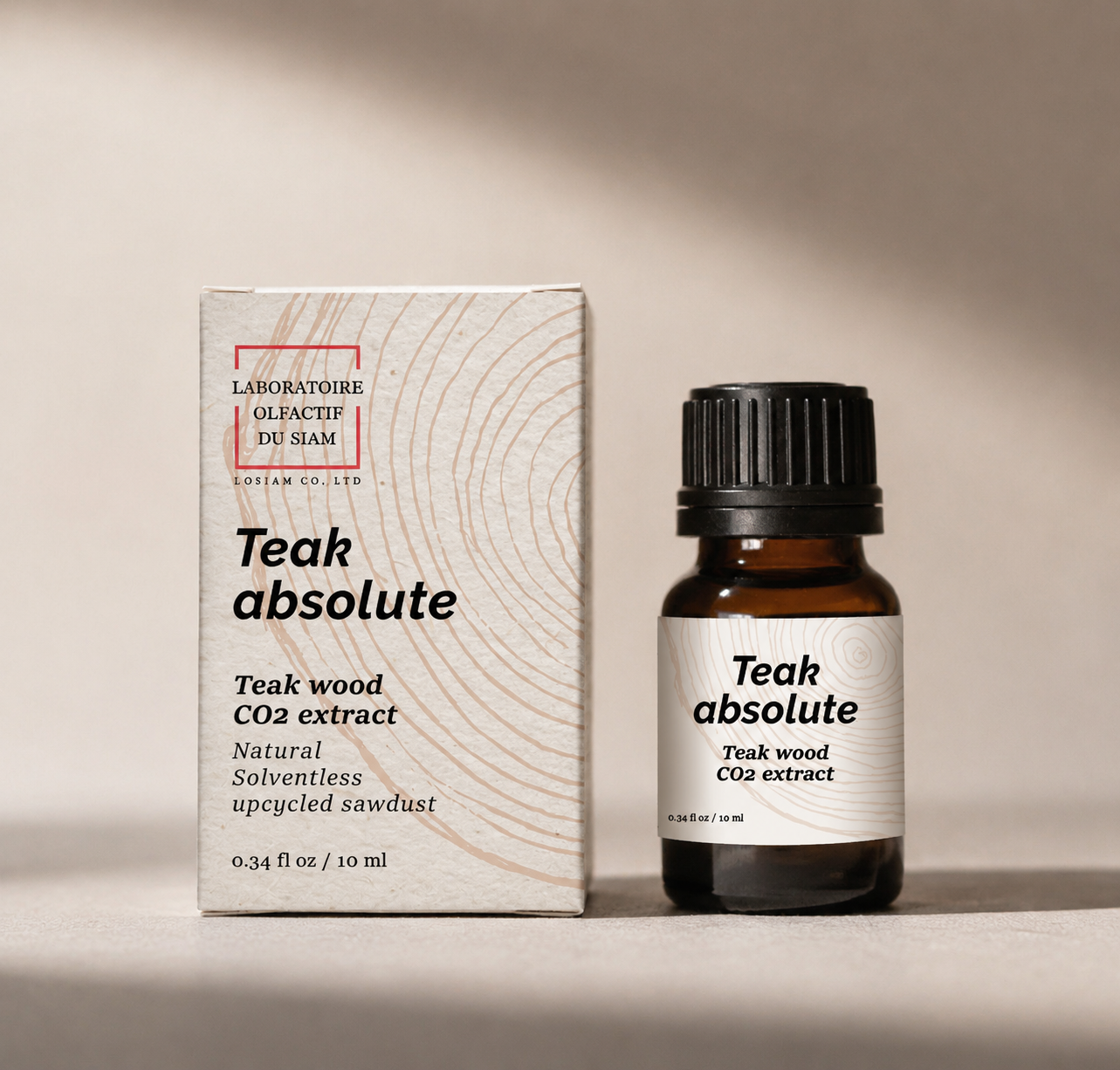
LOSiam produces and supplies this teak wood CO2 extract from its lab in Chiang Mai, Thailand. Perfumers and fragrance houses can request a sample.
LOSiam's Teak CO2 Extract, Developed with CMU, FIN & DIPROM
There are ideas that start with a question nobody thinks to ask twice: what happens to the sawdust?
At every sawmill and workshop that cuts Thai teak, the answer used to be simple — it's waste. Swept up, discarded, sometimes burned. At LOSiam, that sawdust became the starting point for a new fragrance ingredient: Teak Absolute, a CO2 extract of Thai teak wood, developed at our lab in Chiang Mai and now part of a national bio-industry development program.
A national selection, a local project
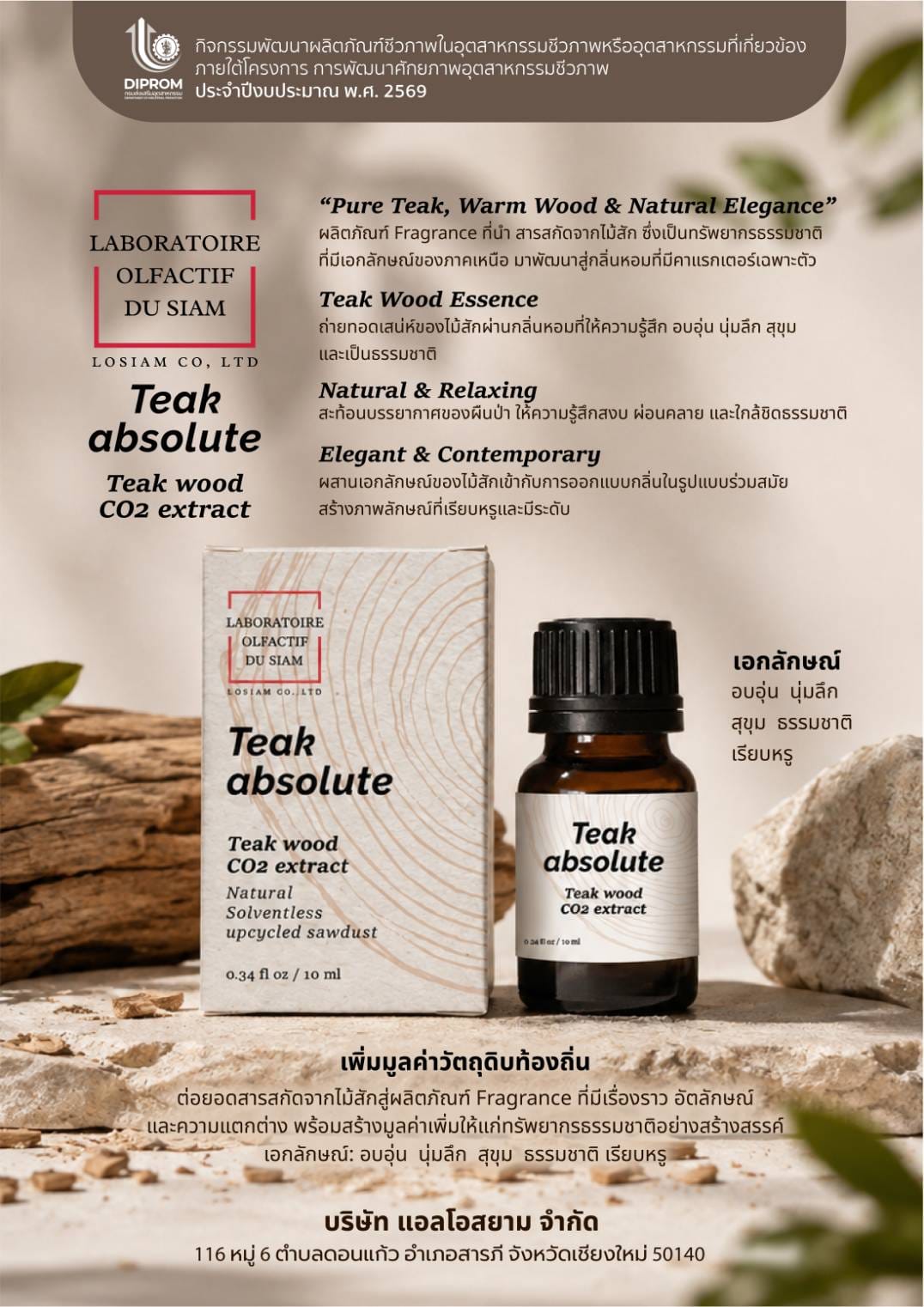
This year, LOSiam was selected as one of three companies nationwide for the Department of Industrial Promotion's (DIPROM) FY2026 program supporting the development of bio-industrial products. The project centers on our teak wood work, carried out with two partners who've been close to LOSiam since the beginning: CMU Biopolis, where our lab is based, and the Food Innovation & Packaging Center (FIN).
It's the kind of recognition that's easy to reduce to a headline — a grant, a program, a logo. What it actually represents is a year of lab work on a material nobody in fine fragrance was extracting this way from this source.
Why sawdust, why CO2
Thai teak has always had a place in perfumery adjacent categories — as timber, as furniture, as a cultural material. It has not, historically, had a place as a fragrance ingredient in its own right, partly because there was no way to extract it that didn't rely on the tree being felled specifically for that purpose.
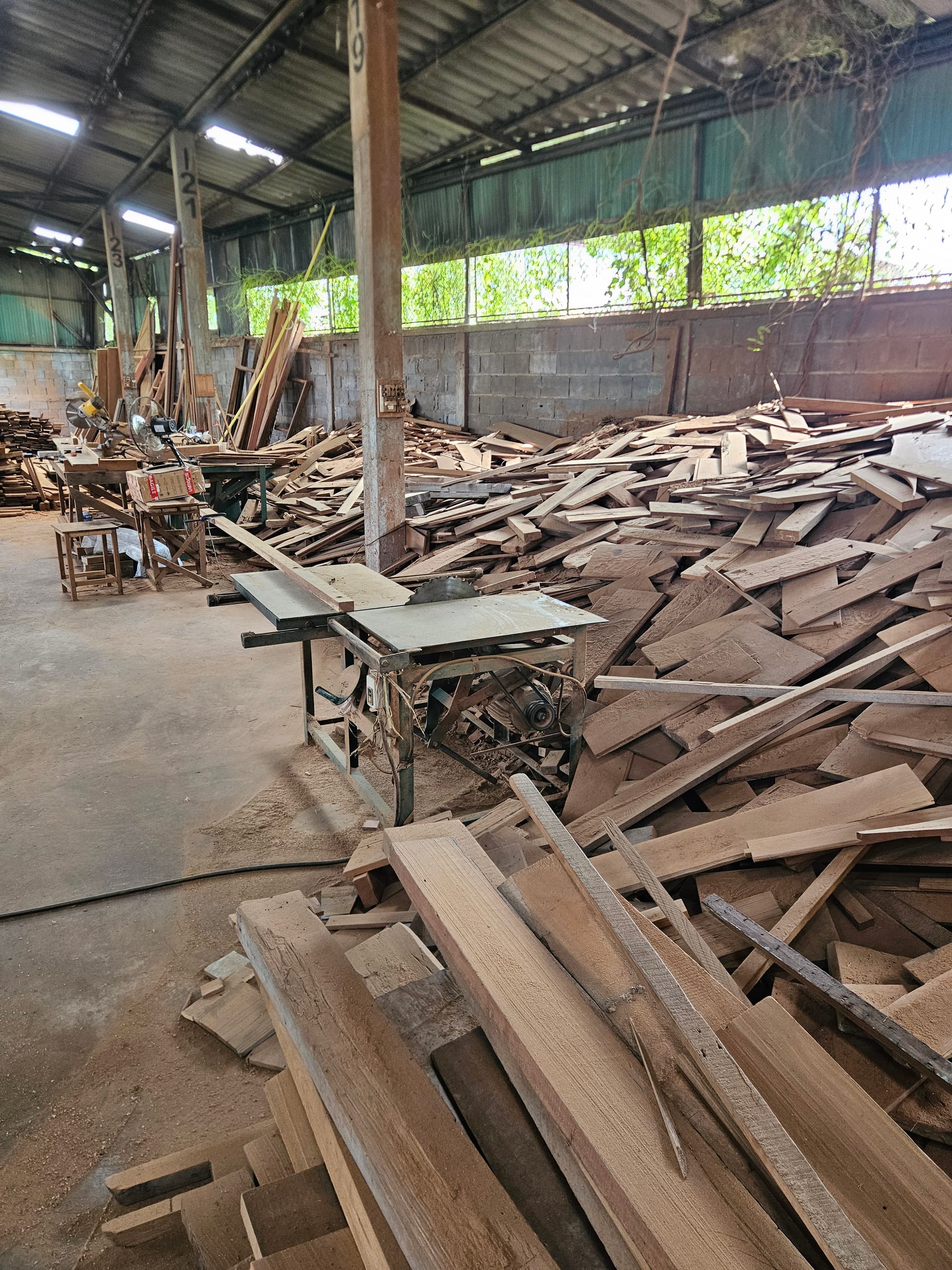
Our approach starts downstream of the sawmill, not the forest. The raw material is upcycled sawdust — a byproduct that already exists, generated by an industry that has no use for it once the cutting is done. Extracting from that sawdust rather than from freshly harvested wood changes the economics and the ethics of the ingredient at the same time: nothing is cut for the sake of the extract.
The extraction itself uses CO2 as the extraction medium — a method perfumers increasingly favor when they want a natural material without residual solvent. It's a technique used across the industry in different configurations; ours has been tuned, over many iterations, specifically for teak's dense, resinous structure. We keep the exact parameters of that process to ourselves, the way most labs do — but the result is on the label: solventless, and true to the character of the wood itself.
Curious what else gets pulled from a waste stream and turned into a fragrance material? Subscribe to hear about the next one before it's public.
What it smells like
Teak Absolute reads as warm, soft, and quietly elegant — closer to the smell of the material itself than to a reconstructed "woody" accord. Where a lot of woody notes in perfumery are built up from synthetic bases, this one carries the actual resinous, slightly smoky depth of teak, softened by the CO2 extraction into something wearable rather than raw.
It's a small-batch material by nature — 10ml bottles, sourced from a byproduct stream that doesn't scale the way a purpose-grown crop would. That's not a limitation we're working around; it's close to the point.
The collaboration behind it
None of this happened in isolation. CMU Biopolis has hosted LOSiam's lab since our move to the campus, and FIN's food-and-packaging innovation expertise has shaped how we think about processing byproduct streams responsibly. DIPROM's selection of the project for FY2026 support gives it a further year of development, with the kind of institutional backing that lets a small lab push further into R&D than it could alone.
We'll be sharing more from the lab as the program continues — including where the extraction process goes next, and which other Thai byproduct streams might follow teak's path from waste to ingredient.
CO2 extraction is one of four routes we use to turn a raw material into what's in the bottle. See how it compares to a traditional concrete-to-absolute process or a renewable-solvent maceration in our Perfumer's Glossary of Natural Extraction.
Explore further. If this material interests you, see also our Old Teak Sawdust Absolute and our Aromatic Litsea Absolute. The full range is on Our Products. To evaluate several materials at once, see the Discovery Kits.
Technical data
Botanical name: Tectona grandis
Extract part: Upcycled sawdust
Form: CO2 extract
Olfactory family: Woody, resinous, smoky
Process: Supercritical CO2 extraction (solventless)
CAS: 93334-56-6
EINECS: 297-131-0
FEMA: N/A
Harvest window: N/A — continuous byproduct stream, not seasonal
Origin: Upcycled sawmill sawdust, Chiang Mai, Northern Thailand
Interested in evaluating Teak Absolute for your next project?
https://www.losiam.com/contact/
LOSiam (Laboratoire Olfactif du Siam) is a botanical extraction lab based at CMU Biopolis, Chiang Mai, Thailand, producing rare absolutes and CO2 extracts from local Thai botanicals for the fine fragrance industry.
Comments ()